
RSUs, ISOs & ESPPs: Equity Compensation Explained
There’s a strange ritual that happens every year in offices like yours all across the country: an HR portal sends out a notification about your equity compensation grant, you read it with the same focus you’d give a software update agreement, and then you blindly click “accept” and move on. The grant sits in the corner of your benefits dashboard, gathering complexity like dust, until one day it represents a meaningful chunk of your net worth. And that’s when you realize you never actually figured out how it works.
If that sounds familiar, you’re in good company. Equity compensation is the most poorly explained part of nearly all pay packages, yet the cost of ignorance – and ignoring – it can run into six figures. The mechanics matter. So does the tax treatment. And the strategy for what to do with vested shares matters most of all.
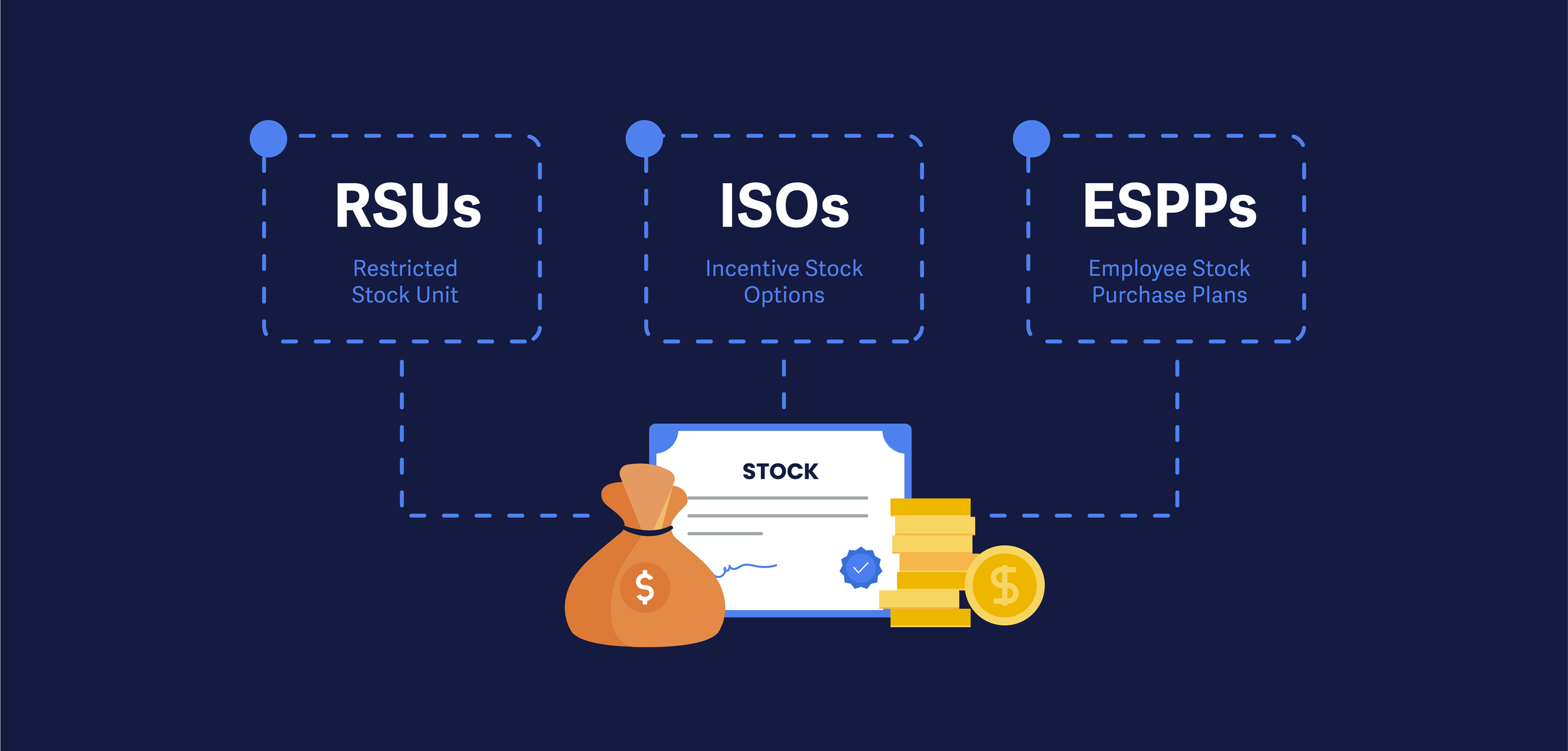
Sound confusing? No worries. Below, we’ll walk through the four main types of equity compensation – RSUs, ISOs, NSOs, and ESPPs – and the framework you need to manage them well. Whether your equity comp represents 10% or 60% of your total compensation, the same fundamentals apply.
Key Takeaways
- RSUs are taxed as ordinary income at vesting, and the standard 22% federal withholding usually isn’t enough for high earners, often leaving a surprise tax bill come April.
- ISOs can deliver long-term capital gains treatment if you meet the holding requirements, but exercising them can trigger the Alternative Minimum Tax (AMT); NSOs are simpler, taxed as ordinary income at exercise.
- ESPPs are often the best deal hidden in your benefits package because the 15% discount plus a look-back feature can push the effective discount above 20%, sometimes 30-40% in a strong run.
- Concentration risk is the silent danger – 40% of Russell 3000 stocks have suffered 70%+ losses since 1980, so use the “would I buy this stock today with cash?” test on vested shares.
- Coordinate equity comp with your broader plan. Withholding gaps, AMT exposure, and your state of residence (NJ’s top rate is 10.75%) all shape the right strategy.
4 Types of Equity Compensation
| RSUs | ISOs | NSOs | ESPPs | |
|---|---|---|---|---|
| How it works | Shares granted that vest on a schedule (often 4 years, 1-year cliff) | Right to buy shares at a fixed strike price within a window | Right to buy shares at a fixed strike price within a window | Payroll deductions buy company stock at a discount (often 15%) |
| When taxed | At vesting | At sale (if holding rules met); AMT at exercise | At exercise (spread) + at sale (appreciation) | At sale (discount + gain) |
| Tax rate | Ordinary income | Long-term capital gains if 1 yr post-exercise + 2 yr from grant | Ordinary income on spread; capital gains on later appreciation | Discount = ordinary income; rest depends on holding period |
| Eligibility | Any employee | Employees only | Employees, consultants, board members, advisors | Any participating employee |
| Key risk | Withholding gap — April surprise tax bill | AMT trap on exercise + dual cost basis tracking | Withholding gap; less favorable than ISO tax-wise | Concentration risk if held; capped at $25K/yr of stock purchased |
| Default move | Sell at vesting unless you’d buy with cash today | Coordinate exercise size and timing with tax advisor before Dec 31 | Plan around ordinary income hit on W-2 | Max contribution; sell on purchase (“quick flip”) |
Why equity compensation deserves its own playbook
Equity compensation isn’t just “extra money paid in stock.” It’s a fundamentally different beast from your base salary and treating it like a bonus is one of the most common (and expensive) mistakes high earners make.
Here’s why it deserves its own strategy:
The tax treatment varies dramatically depending on the type of equity (RSUs, ISOs, NSOs, ESPPs).
The withholding your employer applies often falls short of what you’ll actually owe.
Concentration risk grows quietly as your shares accumulate – a single bad quarter can erase years of paper wealth.
The decisions you make about exercising, holding, and selling have tax consequences that compound for years.
The bottom line is that equity compensation requires attention and intention. Letting your shares sit on autopilot is the financial equivalent of letting your 401(k) default into a money market fund: technically a decision, but rarely the right one.
RSUs (Restricted Stock Units)
RSUs are by far the most common form of equity compensation at public companies today. They’re a grant of company shares that vest on a defined schedule – typically over four years, with what’s called a “one-year cliff” at the start. A one-year cliff simply means no shares vest during your first 12 months of employment; after you cross the one-year mark, 25% of your shares vest in a single chunk, and the remainder vest gradually over the next three years (often monthly or quarterly).
Here’s how the mechanics actually work:
Your employer grants you, say, 400 RSUs.
The shares vest on a schedule (often 25% per year over four years).
When shares vest, you receive them automatically – they show up in your brokerage account.
The full value of the vested shares is treated as ordinary income on your W-2 in the year they vest.
Your employer withholds taxes, but here’s where things get interesting.
The RSU withholding gap
Watch out — the RSU withholding gap
Your employer probably under-withholds on your RSUs.
What gets withheld
22%
IRS supplemental wage rate (37% on income above $1M)
vs.
What high earners owe
32–35%
Federal bracket, plus ~9% NJ state tax
For most high earners, that’s a 10–15 percentage point gap on the federal side alone. Add NJ’s ~9% state tax (also rarely fully withheld) and the gap grows further. The result is a surprise tax bill come April, often in the tens of thousands.
The fix: add additional federal withholding via your W-4, make estimated quarterly payments, or set aside a portion of each vested RSU in a separate account earmarked for the eventual tax bill.
Most employers withhold federal taxes on RSU income at the IRS-mandated “supplemental wage” rate of 22% (or 37% on income above $1 million). If you’re in the 32% or 35% federal bracket, that means your employer is under-withholding on your RSU income, often by 10 to 15 percentage points. Add New Jersey’s roughly 9% state tax (which is rarely fully withheld either), and the gap widens further.
The result is a surprise tax bill come April that’s often in the tens of thousands of dollars for high earners with substantial stock vesting.
The fix is straightforward. Our team typically suggests adjusting your W-4 to add additional federal withholding, making estimated quarterly tax payments, or setting aside a portion of vested RSU value in a separate account earmarked for the eventual tax bill.
The “RSUs are a cash bonus paid in stock” framework
Here’s the mental model we find most useful for deciding what to do with vested RSUs. Imagine your employer paid you the full cash value of your vested shares and then asked, “Would you like to invest 100% of this cash bonus in our company’s stock?”
If the answer is ‘no’, you should sell the shares immediately upon vesting and redeploy the proceeds elsewhere. Most people wouldn’t make that exact bet with cash, yet they accidentally make it every quarter by letting vested RSUs accumulate.
ISOs (Incentive Stock Options)
ISOs are the most tax-favored form of equity compensation, granted primarily to early employees at venture-backed startups. They give you the right to buy company stock at a fixed “strike price” within a defined window.
Here’s how the mechanics of this work:
Your employer grants you the right to buy, say, 10,000 shares at a $5 strike price.
The options vest over a schedule (typically four years with a one-year cliff, meaning no options vest during your first 12 months, after which 25% vest at once and the remainder vest gradually thereafter).
After vesting, you can “exercise” the options – pay the strike price to acquire the shares.
If you meet two specific holding requirements, the eventual gain is taxed at long-term capital gains rates rather than ordinary income rates.
To qualify for the favorable tax treatment, you must satisfy both holding periods: hold the shares for at least one year after exercise, and at least two years from the original grant date. Meet both, and the entire gain (from strike price to sale price) is taxed at long-term capital gains rates – a meaningful break for high earners.
The AMT trap
The ISO AMT Trap: How $450K of “Phantom” Income Gets Created
Example: exercising and holding 10,000 ISOs.
Strike price
What you pay per share to exercise
$5
Fair market value at exercise
What the share is worth on exercise day
$50
Shares exercised
Total ISOs exercised in the year
10,000
The spread (added to AMT income)
($50 − $5) × 10,000 shares
$450,000
Potential AMT bill
$80K–$100K
due in April with cash you may not have set aside
The $450,000 spread doesn’t hit your regular tax return — but it’s fully added to AMT income. Depending on your other tax situation, that can produce an AMT bill in this range.
AMT paid on an ISO exercise generates an AMT credit recoverable in future years — but the cash is gone now. Always coordinate with your tax preparer before exercising.
Here’s where ISOs get complicated. The IRS calculates two parallel tax figures: regular income tax (which doesn’t consider an ISO exercise) and Alternative Minimum Tax, or AMT (which does). You pay whichever is higher.
When you exercise ISOs and hold the shares (the path required for favorable long-term capital gains treatment), the spread between your strike price and the fair market value at exercise becomes an “AMT preference item.” Translation: it doesn’t show up on your regular tax return, but it can dramatically increase your AMT.
Walking through the math with real numbers, assume the following:
Strike price: $5 per share
Fair market value at exercise: $50 per share
Shares exercised: 10,000
The spread is ($50 − $5) × 10,000 = $450,000. None of that hits your regular tax return, but the full amount is added to your AMT income. Depending on your other tax situation, that can generate an AMT bill in the $80,000-$100,000 range, due in April, with cash you may not have set aside.
The good news is that AMT paid on an ISO exercise generates an “AMT credit” you can recover in future years when your regular tax exceeds your AMT. The harder news: the cash is gone now, and you have to track the credit carefully across multiple tax years.
Our team typically suggests a few strategies for managing AMT exposure on ISOs. Exercise fewer ISOs per year so you stay under the AMT crossover point. Exercise early in the calendar year so you can decide before December 31 whether to do a same-year sale (which avoids AMT but loses the favorable capital gains treatment). And – always – coordinate with your tax preparer before you click “exercise.”
Dual cost basis tracking
ISO exercises create a wrinkle most people don’t anticipate: your shares have one cost basis for regular tax purposes (your strike price) and a different, higher cost basis for AMT purposes (the fair market value at exercise). When you eventually sell the shares, you need to track both, or risk being double-taxed by accident.
NSOs (Non-Qualified Stock Options)
NSOs are the more flexible cousin of ISOs. They work mechanically the same way – a right to buy shares at a fixed strike price within a defined window – but the tax treatment is simpler and less favorable.
When you exercise an NSO, the spread between your strike price and the fair market value at exercise is taxed as ordinary income in that year. Your employer withholds taxes at the supplemental rate, just like with RSUs (and the same withholding gap applies for high earners).
From that point forward, your cost basis in the shares equals the fair market value at exercise. Any appreciation after that is taxed as capital gains – long-term if you hold the shares for more than a year before selling.
Why use NSOs at all if ISOs are more tax-favored? Two reasons. NSOs can be granted to non-employees (consultants, board members, advisors), and they don’t carry annual exercise limits or AMT exposure. For employers, that flexibility often matters more than the tax advantage.
For employees, the planning is more straightforward than with ISOs: pick your exercise timing based on stock price expectations and your tax brackets, plan for the ordinary income hit on your W-2, and don’t be surprised when the withholding falls short. For a plain-English primer on how employee stock options work overall, see our guide to employee stock options.
ESPPs (Employee Stock Purchase Plans)
The ESPP Look-Back: Why 15% Isn’t Really 15%
The headline discount is just the floor. The look-back is where the real value lives.
Flat market
15%
effective discount
Stock price unchanged across the 6-month offering period — you get the standard discount.
Rising market
20–30%
effective discount
Look-back means you buy at 15% off the lower price — either the start or end of the period.
Strong run
Up to 40%
effective discount
Big stock-price gains across the offering period stack on top of the 15% discount.
Example
Stock is $100 at the start of the offering period and $130 at the end. The look-back lets you buy at 15% off the lower price ($100), so you pay $85/share for stock now worth $130. That’s an effective discount of about 35% — far above the headline 15%.
ESPPs are arguably the best deal hidden in most benefits packages – and most employees don’t take full advantage of them.
Here’s how a typical ESPP works:
You elect to contribute a percentage of your salary (often up to 15%, capped at $25,000 of stock purchased per calendar year).
Contributions accumulate via payroll deduction over a six-month “offering period.”
At the end of the period, the accumulated cash is used to buy company stock at a discount, typically 15% off.
Many plans include a “look-back” provision, meaning the discount applies to the lower of the stock price at the start or the end of the offering period.
The look-back is the part that makes ESPPs genuinely powerful. If the stock price rises during the offering period, you’re buying at a 15% discount off the price six months ago. That can translate to a 20%, 30%, or even 40% effective discount in a strong run.
The “quick flip” strategy
Many employees sell their ESPP shares the moment they’re purchased, locking in the discount as a near-guaranteed gain. The tax treatment is messier in this scenario (the discount becomes ordinary income, and any small additional gain is short-term capital gain), but the strategy effectively turns your ESPP into a tax-advantaged cash bonus.
Holding ESPP shares longer can convert more of the gain to long-term capital gains, but the math rarely justifies the concentration risk for most young professionals. We find that the cleanest approach is to participate at the maximum contribution rate, sell on purchase, and treat the proceeds as part of your broader investment strategy.
Concentration risk: the silent threat
Watch out — concentration risk
Your employer’s stock might be the next great success story — or it might not.
~40%
of stocks in the Russell 3000 have suffered a 70%+ decline from peak with little recovery (1980–present, per JP Morgan)
When your paycheck and your equity both come from the same employer, your financial life is already concentrated in one place. Continuing to hold vested shares simply doubles down on a bet you’re already making with your career.
Rule of thumb
Don’t let any single company’s stock (including your employer’s) exceed 10–15% of your investable net worth. The exact number depends on your overall picture — but the principle stays consistent: concentrate cautiously, diversify deliberately.
Here’s a stat that should give every equity-comp recipient pause: a long-running JP Morgan study of every stock in the Russell 3000 since 1980 found that roughly 40% have suffered a ‘catastrophic loss’, defined as a 70%+ decline from peak with little subsequent recovery. Your employer might be the next great success story – or it might be a cautionary tale you’ll be telling 10 years from now.
When your paycheck and your equity both come from the same company, your financial life is already concentrated in one place. Adding more by continuing to hold vested shares simply doubles down on a bet you’re already making with your career.
The “would I buy this stock today with cash?” test
Smart strategy
The one question that cuts through every equity comp decision.
“If my vested shares were converted to cash right now, would I use that cash to buy this stock at today’s price?”
Yes
Keep holding. You’re actively choosing the concentration risk because you believe in the upside.
No
Sell the shares. Holding them is the same bet as buying them with cash — just disguised as inaction.
For most people, the honest answer is no — they wouldn’t make that exact bet with their savings. Yet they make it accidentally, every quarter, by letting vested RSUs and exercised options accumulate.
Here’s the framework that cuts through the emotional clutter. Imagine your vested RSUs (or exercised options) were converted to cash, and you had to decide whether to invest that cash in your employer’s stock at today’s price.
For most people, the honest answer is ‘no.’ They wouldn’t make that exact bet with their savings. If that’s your answer too, the math is clear: sell the shares, redeploy the proceeds into a diversified portfolio, and stop accidentally re-buying every vesting cycle.
A reasonable rule of thumb: don’t let any single company’s stock (including your employer’s) exceed 10-15% of your investable net worth. Some clients are comfortable holding more; some prefer less. The right number depends on your overall picture, but the principle stays consistent: concentrate cautiously, diversify deliberately.
Coordinating equity comp with the rest of your plan
Equity compensation doesn’t exist in a vacuum. It interacts with your salary, your retirement contributions, your tax bracket, your state of residence, and your broader financial goals. If you're still getting a handle on that retirement piece, our guide to how a 401(k) works is a good starting point. A few coordination points worth flagging:
Use vested RSU proceeds (or option exercise gains) to fund tax-advantaged accounts whenever possible – Backdoor Roth IRAs, Mega Backdoor Roths if your 401(k) allows, and HSAs.
Coordinate large equity events with your other tax decisions in the same year – charitable giving, Roth conversions, and tax-loss harvesting opportunities all interact.
For executives, consider a 10b5-1 trading plan. These pre-arranged sale schedules let you systematically sell shares without running afoul of insider trading rules or the optics of trading on information. Most major employers can set them up through their stock plan administrator.
Update your withholding strategy every January once you have visibility into the year’s expected vesting and exercise schedule.
A quick note for our New Jersey neighbors
If you’re reading this anywhere across the state of New Jersey, the tax landscape adds an additional layer to equity comp planning:
New Jersey taxes equity compensation as ordinary income – so the federal withholding gaps that bite high earners also apply at the state level.
The top NJ marginal rate of 10.75% kicks in at $1 million of income, which a strong year of RSU vesting or option exercises can easily push you into.
New Jersey treats Section 83(b) elections differently than the federal code in some early-stage situations, which is a wrinkle worth flagging for startup employees who receive restricted stock (not RSUs) before a company goes public.
For high earners with significant equity comp, the combined federal-plus-NJ marginal rate can approach 45%. This is exactly why coordinating equity comp with your broader tax plan matters more for NJ residents than for residents of zero-income-tax states.
The bottom line
Equity compensation can be one of the most powerful wealth-building tools in your career—or one of the most stressful, depending on how well you understand the mechanics. The encouraging part: the rules don’t actually change much from year to year. Once you’ve internalized how RSUs, ISOs, NSOs, and ESPPs work, the playbook stays consistent.
The strategies that consistently move the needle are also relatively simple. Sell vested RSUs by default. Manage AMT exposure on ISO exercises. Max out your ESPP discount. Treat concentration risk as a real threat, not a theoretical one. And coordinate every equity event with your broader tax plan.
If you’d like a closer look at how your specific equity comp situation should be structured, schedule a FREE discovery call with one of our CFP® professionals.
Reviewed for accuracy
Benjamin Stark, CFP®
Financial Advisor and Director of Client Experience at Vision Retirement, with 10+ years as a financial advisor.
Read full bio →FAQs
-
For most young professionals, selling at vesting is the cleaner default. RSUs are taxed as ordinary income when they vest regardless of whether you sell, so holding them turns the proceeds into a concentrated, untimed bet on your employer’s stock. The “would I buy this stock today with cash?” test is the easiest way to decide: if the answer is ‘no’, sell and redeploy. The exceptions are typically lock-up periods (just after an IPO), insider trading window restrictions, or active 10b5-1 trading plans that govern the timing.
-
ISOs (Incentive Stock Options) are tax-favored options available only to employees, offering potential long-term capital gains treatment if you meet specific holding periods – plus an AMT trap to navigate. NSOs (Non-Qualified Stock Options) can be granted to employees and non-employees alike, are simpler tax-wise, and trigger ordinary income at exercise on the spread between strike price and fair market value. ISOs deliver better tax treatment when the math works out; NSOs offer flexibility and predictability.
-
The Alternative Minimum Tax (AMT) is a parallel tax calculation that runs alongside your regular income tax. The IRS calculates both and makes you pay whichever is higher. AMT most commonly affects high earners who exercise and hold ISOs. The bargain element (the spread at exercise) is included in AMT income but not regular income, which can push your AMT above your regular tax. The standard fix is to coordinate the size and timing of ISO exercises with a tax advisor well before December 31.
-
In almost every case, yes – and often substantially more than the headline 15%. Plans with a look-back feature can deliver effective discounts of 20-40%, depending on stock price movement during the offering period. The simplest “quick flip” strategy (sell shares immediately upon purchase) locks in the discount with minimal concentration risk. For most participants, maxing out ESPP contributions is one of the highest-return uses of payroll dollars available.
-
A 10b5-1 plan is a pre-arranged stock sale schedule that lets executives and other insiders sell company stock without running afoul of insider trading rules. You set the parameters in advance – how many shares to sell, on what dates, at what prices – and the plan executes automatically. They’re especially useful for senior leaders who are routinely in possession of material non-public information. Most public-company stock plan administrators offer them; ask your benefits or legal team.
-
Most plans give you a 90-day window after your termination date to exercise vested options before they expire. ISOs add a wrinkle: if you exercise more than 90 days after termination, they automatically convert to NSOs (losing the favorable tax treatment). Some companies offer extended post-termination exercise windows of 5 or 10 years, but those are the exception, not the rule. Plan for both the cash needed to exercise and the tax bill that follows before you have the resignation conversation, not after.
-
Generally, no. The IRS prohibits this kind of self-dealing through the “prohibited transaction” rules for IRAs. You can hold company stock that you purchase through your 401(k) directly (some plans offer this option), but you can’t move shares you already own into a retirement account. The cleaner path is to sell vested equity, fund your retirement accounts with the proceeds, and let those accounts invest in a diversified portfolio.


Disclosures:
This document is a summary only and not intended to provide specific advice or recommendations for any individual or business.