
Portfolio Diversification: Why It’s Important
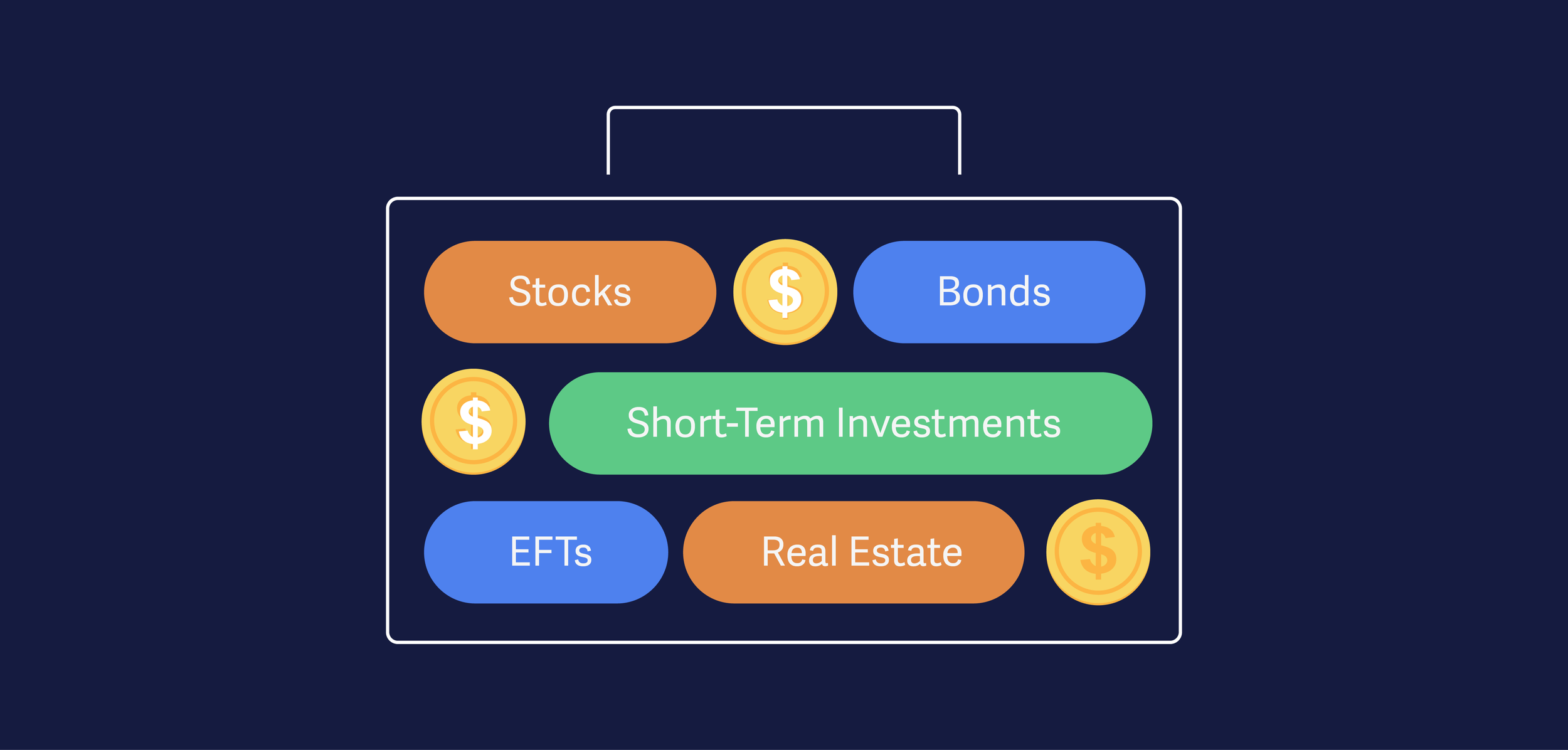
While the saying “Don’t put all your eggs in one basket” might sound cliché, the truth behind it is powerful—especially when it comes to investing. No matter how confident you are in a single stock or even sector, concentrating all your money in one place is risky. Diversification, the practice of spreading your investments across different asset types, sectors, and regions, exists to limit this same risk.
Key Takeaways
- What it is: Diversification means spreading investments across asset classes, sectors, and regions so no single company, industry, or country failure can sink your portfolio.
- Why it matters: A diversified portfolio reduces the damage from underperformers, smooths out market swings, and helps you stay disciplined — investors who panic-sell during downturns often miss the recovery.
- Four ways to diversify: Spread holdings across asset classes (stocks, bonds, cash, real estate), sectors and industries, geographies (U.S. and international), and investment styles or sizes (growth vs. value, small- vs. large-cap).
- Easy building blocks: Mutual funds, ETFs, and target-date funds provide built-in diversification across dozens or thousands of securities with a single purchase — no need to handpick each holding.
- Common mistakes: Holding three different tech funds isn't real diversification if they all move together — and forgetting to rebalance can quietly turn a 60/40 portfolio into 75/25 after a long bull run.
What is portfolio diversification?
At its core, portfolio diversification is all about balance rather than eliminating risk (which is, quite frankly, impossible). Diversifying is likewise about managing your portfolio in a way that gives you the best chance to achieve your long-term financial goals as a cornerstone for both new and seasoned investors alike.
Rather than owning just a few stocks, a diversified investor might hold hundreds of different companies spread across industries and geographies—combining investments that behave differently under different conditions. During periods of rapid economic growth, for example, stocks historically deliver strong returns whereas a slow or contracted economy sees bonds typically holding up better as investors flock to safer assets. In holding both types of investments, you reduce the odds of your entire portfolio suffering all at once.
Diversification benefits
Diversification offers several clear advantages that make it a fundamental part of smart investing. Not just a defensive strategy, it’s likewise offensive as a way to balance risk and reward while staying committed to long-term investing goals. More specifically, diversification…
Reduces the impact of poor performers
Even the best-run companies or most promising sectors underperform from time to time. Think of once-dominant corporations that eventually collapsed as technology and consumer habits evolved; Kodak and Blockbuster are two notable examples. While investors who held only these companies faced devastating losses when they went belly up, those who spread their money across multiple industries and asset classes were cushioned against this same downfall. In this way, a single company’s failure has only a minor effect on a diversified portfolio since stronger investments help offset any losses.
Smooths out returns
Markets are inherently volatile, with values rising and falling daily—sometimes dramatically. A diversified portfolio doesn’t eliminate these swings, but it makes them gentler and easier to ride out.
For example, when stocks decline during a recession, bonds often rise in value as investors seek safety: a balancing effect that helps stabilize performance. A smoother ride is crucial for investors because it encourages them to stay invested, with history repeatedly showing that those who panic and sell during downturns often miss the recovery and lock in losses rather than participate in the rebound. Diversified investors, in contrast, experience less extreme volatility and thus find it easier to stay disciplined and patient.
Creates opportunities for growth
Concentrating in a single asset may feel safe if that investment is performing well, but it also blinds you to other opportunities. For example, while U.S. stocks have delivered strong returns over the past decade, earlier decades saw periods of superior international market performance. Similarly, technology companies have recently been responsible for much of the market’s gains whereas other sectors (e.g., healthcare or energy) may lead in the future. Diversifying gives you exposure to diverse industries, regions, and asset classes, some of which may exceed expectations.
Keeps emotions in check
Investing isn’t just about numbers but also managing human psychology. Fear and greed, after all, are powerful forces feeding troublesome financial decisions such as panic-selling during market crashes or chasing after the latest “hot” investment trend. A balanced portfolio is less vulnerable to extreme swings and thus helps reduce anxiety and keep emotions in check.
Portfolio diversification strategies
There’s more than one way to diversify. In fact, the strongest portfolios don’t rely on a single tactic but a nice mix of strategies providing multiple layers of protection and opportunity: each one addressing a different source of risk and ensuring your investments aren’t overly dependent on any one factor for success. You can diversify…
By asset class
The most popular method is to spread investments across different asset classes—stocks, bonds, and cash—with each playing a distinct role. Stocks provide the potential for long-term growth, bonds generate stability and income, and cash reserves offer safety and liquidity for emergencies or new opportunities. Diversification doesn’t stop with these three, however, as many investors add real estate (either directly via property ownership or indirectly via real estate investment trusts (REITs)), commodities (e.g., gold or oil), or alternative assets such as private equity, venture capital, or hedge funds.
By sector and industry
Diversification by sector and industry is equally important within the stock market itself. The economy is vast, and not all industries move in lockstep. Technology companies may soar during periods of innovation, while energy stocks lag if oil prices are low. Sometimes the reverse is true, with energy companies thriving when oil demand spikes and tech slowing down in the midst of regulation or less consumer interest. Healthcare tends to be more resilient in downturns because people always need medical care, whereas other sectors grounded in discretionary consumer spending can suffer when households tighten the purse strings. Spreading investments across multiple sectors ultimately reduces your risk of being caught in the crosshairs of a single-industry decline.
By geography
Geography is another powerful layer of diversification, with global opportunities indeed very much in play despite U.S. investors often defaulting to American companies because they’re familiar and accessible. Developed markets (e.g., Europe and Japan) can offer stability, while their emerging counterparts such as India, Brazil, and parts of Southeast Asia may deliver higher growth potential. When U.S. markets stagnated after the tech bubble burst in the early 2000s, for example, many international markets delivered strong returns to keep globally diversified investors on track.
By investment style and size
Diversification also extends to investment style and company size. Growth stocks—shares of companies expected to expand rapidly—behave very differently from value stocks that are priced lower relative to fundamentals (e.g., earnings or book value). While the former can soar in bull markets but fall harder during downturns, the latter often display steadier, more resilient performance. Company size adds another dimension as well, with small-cap companies typically more volatile but offering outsized growth opportunities and large-cap companies often more established, stable, and predictable (and mid-cap businesses striking a balance between the two). In combining different styles and sizes, investors create a more balanced portfolio that benefits from multiple market dynamics rather than leaning on one type of company to carry the load.
How to build a diversified portfolio
While some investors prefer to cherry-pick individual stocks and bonds, this approach requires significant research and effort to build meaningful diversification.
Mutual funds and exchange-traded funds (ETFs) provide a simpler, more efficient way to go about it, with a single fund holding dozens, hundreds, or even thousands of securities to provide “built-in” diversification across asset classes, sectors, or regions.
A total market index fund instantly provides exposure to thousands of U.S. companies, for example, while an international ETF can expand your reach into global markets with one purchase.
Target-date funds, often used in retirement accounts, automatically adjust diversification over time while gradually shifting from stocks to bonds as the target retirement date approaches.
Vehicles like these make diversification more accessible to everyday investors, removing the need to handpick each and every portfolio component.
Diversification costs and tradeoffs
Diversification is powerful, but it’s not without some trade-offs. One downside? It can dilute returns. If you happen to own the best-performing stock of the year but it’s just one small portion of a larger portfolio, you won’t fully benefit. In other words, while diversification helps you avoid disastrous losses, it also means you’re less likely to “hit a home run.” Diversification also doesn’t protect you from broad market downturns as diversified portfolios aren’t immune when global markets fall—though they do typically decline less severely and recover more steadily.
Common diversification mistakes
Even smart investors can stumble when trying to diversify. One common mistake is assuming you’re diversified when your assets are highly correlated. For example, owning three different technology funds may feel like diversification, but in reality, they all rise and fall together.
Another common mistake is forgetting to rebalance. Over time, some assets grow faster than others and thus cause one’s allocation to drift (e.g., a portfolio that begins as 60% stocks and 40% bonds may shift to 75% stocks after a long bull run). A failure to rebalance may cause you to take on more risk than you originally intended in this case.
In sum: portfolio diversification
The best portfolios out there aren’t built on predictions or bets but instead principles, with diversification—time and again—proving itself as one of the most enduring financial tenets. In spreading your investments across asset classes, sectors, and regions, you help protect yourself from unpredictable circumstances and increase your chance of long-term success. Whether you’re just starting out or already managing a substantial portfolio, now is the time to step back, review your holdings, and ask: Am I truly diversified?
Have questions about investing or portfolio diversification? Schedule a FREE discovery call with one of our CFP® professionals to get them answered.
Reviewed for accuracy
Benjamin Stark, CFP®
Financial Advisor and Director of Client Experience at Vision Retirement, with 10+ years as a financial advisor.
Read full bio →


Disclosures:
This document is a summary only and is not intended to provide specific advice or recommendations for any individual or business.
There is no assurance that the techniques and strategies discussed herein are suitable for all investors or will yield positive outcomes. Investing involves risks, including possible loss of principal.
No strategy assures success or protects against loss. There is no guarantee that a diversified portfolio will enhance overall returns or outperform a non-diversified portfolio. Diversification does not protect against market risk.