
Stock Splits, Explained
This post covers the basics of stock splits, how they work and impact your investment portfolio, and much more. Without further ado, let's jump right in…
Key Takeaways
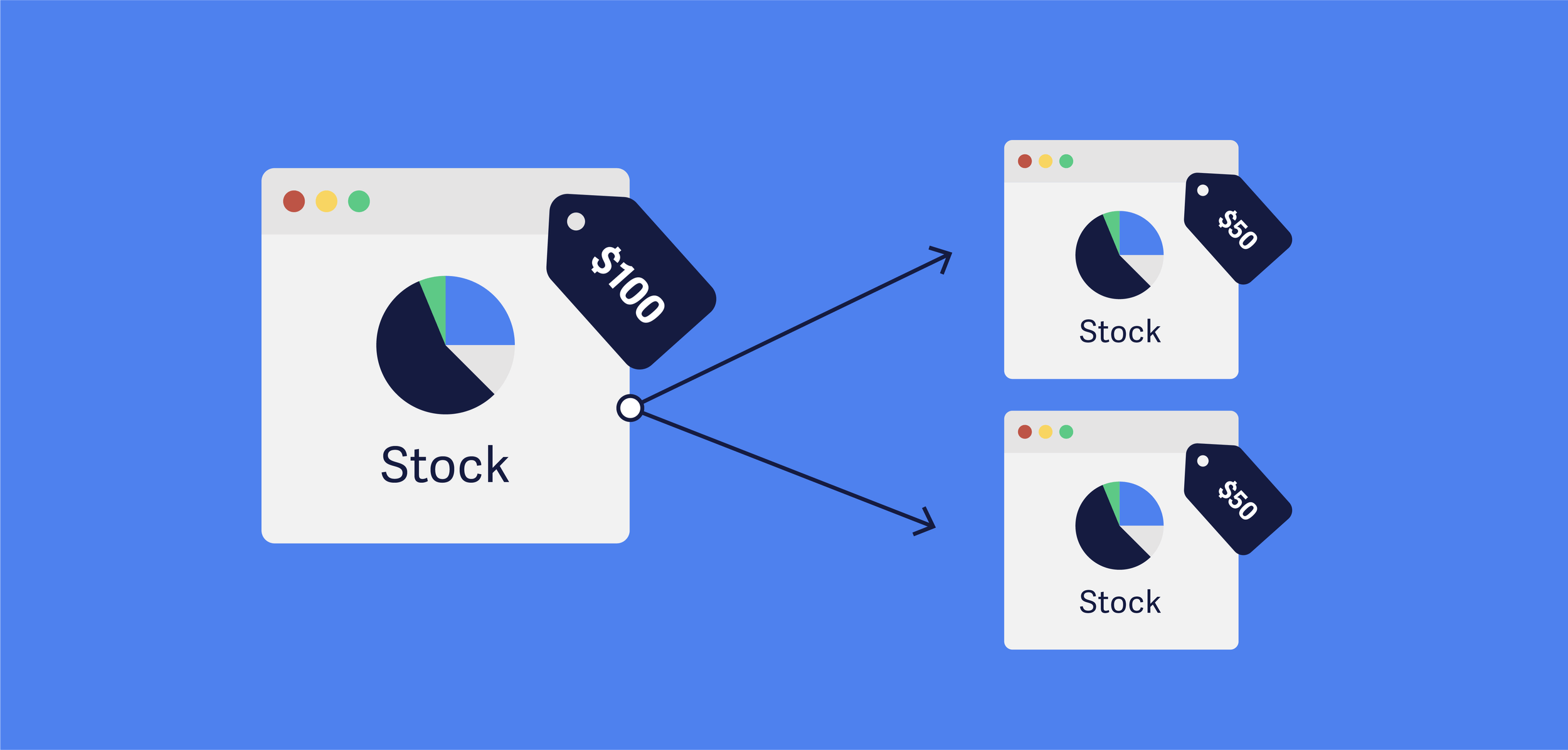
- A stock split increases a company's number of outstanding shares and lowers the price per share; in a 2-for-1 split, 10 shares become 20 (each worth half as much).
- Companies split their stock to make shares more affordable, attract new investors, and improve liquidity by narrowing the bid-ask spread.
- A reverse split does the opposite—combining shares to raise the per-share price—often to avoid delisting or appeal to institutional investors.
- A split doesn't change your stake; you own more (or fewer) shares, but your total value and percentage of company ownership stay the same.
- Stocks have historically outperformed the S&P 500 in the 12 months after a split, though that's a tendency rather than a guarantee.
What is a stock split?
A stock split occurs when a company increases the number of its outstanding shares by issuing additional shares to current shareholders, thus lowering the price per share. Back in 2020, for example, Apple’s 4-for-1 stock split meant the company’s total authorized shares increased from 12.6 billion to over 50 billion.
How does a stock split work?
Stock splits are commonly of the “2-for-1” or “3-for-1” variety. For example, if you as a shareholder own 10 shares of stock worth $100 (with a per-share price of $10) and the company decides to move forward with a 2-for-1 stock split, you’ll then have 20 shares owned of stock worth $100 (with a per-share price of $5) post-split.
How a 2-for-1 Stock Split Works
More shares, lower price — total value unchanged.
Before the split
10 shares
10 × $10/share
Total value
$100
After the split
20 shares
20 × $5/share
Total value
$100
The bottom line
A stock split doesn’t make you richer or poorer. You own more shares at a lower price, but your overall stake in the company — and its total dollar value — stays exactly the same.
Why do companies split their stocks?
Companies most commonly split their stock to make shares more accessible and easier to trade—not to raise money directly, since a split doesn't create new capital. Their typical goals are to…
Make shares more affordable
A company may choose to split its stock when stock prices are too high for the average investor and/or investors see little room for growth. A stock split makes the share price more enticing, boosting the chance additional people will invest in the company.
Stock splits can also attract new investors by lowering the price per share, making shares accessible to a broader audience. For example, Apple engaged in a 4-for-1 forward split back in 2020 when its stock was trading at nearly $500 a share: reducing the price to about $125 per share, attracting more investors. Two years later, Amazon initiated a 20-for-1 forward split when its stock was valued at almost $2,500 per share (resulting in a post-split price of $124). NVIDIA, meanwhile, completed a 10-for-1 forward split in 2024 to bring its stock price of $1,200 down to $120 per share.
3 Famous Forward Stock Splits
When prices climbed too high, these companies made shares accessible again.
Apple
2020
4-for-1
Split ratio
Amazon
2022
20-for-1
Split ratio
NVIDIA
2024
10-for-1
Split ratio
Share-price figures are approximate, rounded to the nearest dollar at the time of each split.
See a short-term spike
Another benefit of stock splits is they can also boost share prices in the short term since lower prices theoretically increase demand. Per research highlighted on Smartasset.com, stock splits tend to be good for this with stocks significantly outperforming the S&P for the first 12 months post-split.
Increase liquidity
Another popular reason to pursue a stock split is to increase liquidity, as the lower price often leads to higher trading volumes. The bid-ask spread—the difference between the highest price a buyer will pay and the lowest price a seller will accept—narrows as a result of this and makes it easier to trade.
Why some companies don't perform stock splits
Not all companies split their stock. Here are some common reasons why:
For prestige
Some companies believe a higher stock price gives their company an air of esteem with perceptions of value outshining a lower price. One great example? Berkshire Hathaway, whose Class A shares have never split and are valued over $700,000 per share—although the company does offer Class B shares (with fewer voting rights) as a reasonably priced alternative. In this way, the company's decision not to split can enhance the company's perceived value and reinforce its unique market image among investors.
To avoid risk
Stock splits do involve potential risk, especially if an unexpected financial event (e.g., a recession or other bad news for companies) immediately follows one. Why? Because this often drives down the price per share even more, perhaps spooking investors and/or—in worst-case scenarios—seeing the price tumble below listing requirements and thus plucking the company from the stock exchange, limiting its ability to raise capital.
What is a reverse stock split?
Companies can also do the opposite and replace existing shares with a proportionate number of smaller ones via a “reverse split.” A “1-for-2” reverse split, for example, replaces two existing shares with one new one—meaning if you owned 100 shares of stock, you’d now own 50 at the same overall value.
Why some companies perform reverse stock splits
Companies with low share prices often carry out reverse stock splits for various reasons in order to…
Avoid delisting
One key motivation for a reverse stock split is to prevent the risk of delistment from an exchange due to a failure to meet the minimum price requirement. In executing a reverse split, companies can increase their share price and maintain their listing status. For example, Allbirds (an apparel company) announced a 1-for-20 reverse stock split in September 2024 to get back in compliance with the Nasdaq minimum bid price requirement and thus avoid delisting.
Attract specific investors
Reverse stock splits can also help attract certain types of investors—particularly institutional investors—who may steer clear of low-priced stocks. A higher share price can make the stock more appealing to this group.
Change market perceptions
Conducting a reverse stock split can improve investor perceptions of a company and help ensure the stock remains within a typical trading range. Sirius XM Holdings Inc., for example, executed a 1 for 10 reverse stock split back in September 2024. Why? To lift its stock out of the penny-stock range and become more attractive to investors with the company set to spin off as an independent entity.
Reverse/forward stock splits
Although less common overall, a company looking to reduce the burden and administrative cost attached to communicating with investors may decide to eliminate smaller ones via a “reverse/forward split.” This involves two different stock splits: a reverse split conducted to reduce the overall number of shares (triggering cashouts among shareholders holding less than minimum requirements) followed by a split increasing the overall number of shares owned by each shareholder.
Forward vs. Reverse Stock Split
| Forward split | Reverse split | |
|---|---|---|
| What it does | Increases share count, lowers price per share (e.g., 2-for-1, 4-for-1) | Decreases share count, raises price per share (e.g., 1-for-10) |
| Why companies do it | Make shares more affordable, attract new investors, boost liquidity | Avoid delisting, attract institutional investors, escape penny-stock territory |
| Real-world example | Apple 4-for-1 (2020), Amazon 20-for-1 (2022), NVIDIA 10-for-1 (2024) | Allbirds 1-for-20 (2024), Sirius XM 1-for-10 (2024) |
| Typical company profile | Strong performer with rising share price | Struggling stock at risk of falling below exchange minimums |
| Impact on your stake | Same ownership percentage — just more, smaller pieces | Same ownership percentage — just fewer, larger pieces |
Key stock split dates
Three important dates are associated with stock splits, including:
Announcement date
The “announcement date” is when a company announces key split details including the ratio (e.g., 2-for-1 or 3-for-1).
Record date
Shareholders must own the stock on the record date to qualify to receive new shares created by the split.
Effective or distribution date
This is the date when the stock split takes effect, with new shares credited to investors' accounts.
Fractional investing and stock splits
Depending on the trading platform (e.g., Robinhood, Stash, or SoFi Invest), investors can now specify how much money they want to invest in a particular company rather than the number of shares they want to buy. If you want to buy a stock valued at $1,000 but only have $200 to spend, for example, you can buy one-fifth of a share (i.e., “fractional investing”). Fractional shares allow investors to own a portion of a share, making investing more accessible to a wider range of people.
Are stock splits good or bad for investors?
On a material basis, a stock split changes nothing for individual investors. You keep the same position and the same percentage of company ownership — you simply hold more shares, each representing a smaller chunk. A 2-for-1 split leaves you with twice the shares at half the price, the same way breaking a $10 bill into two $5s leaves you with the same $10.
So why do companies bother? A lower per-share price can make the stock feel more accessible to everyday investors, improve day-to-day trading liquidity, and keep shares affordable for employee stock plans. A split can also read as a quiet vote of confidence, since a company usually only splits after its share price has climbed for a while.
It's common for demand to rise post-split given the more affordable shares, and a short-term bump in value may result — but there are no guarantees, and any pop tends to be driven by sentiment rather than fundamentals. When Tesla issued a 3-for-1 split in August 2022, for example, shares traded at $288 but were down almost 2% by the end of the next trading day. The takeaway: a split changes nothing about the underlying business — the earnings, growth, and competitive position that actually drive long-term returns are the same the day after as the day before. And with fractional shares now widely available, you no longer need a lower share price to put a set dollar amount to work; you can buy $100 of a $1,000 stock without waiting for it to split.
Reverse splits (covered above) deserve the same scrutiny — since companies often use them just to stay above an exchange's minimum listing price, the real question is why the share price fell far enough to need one.
The bottom line on stock splits
For existing shareholders, a stock split is largely a non-event — your total value and percentage of ownership don't change. The lower price can entice prospective investors, but the split itself says nothing about the underlying business. So don't buy or sell simply because a stock is splitting; judge the company on its fundamentals, and treat the split as the non-event it usually is.
Have questions about stock splits or investing? Schedule a free consultation with one of our CFP® professionals to get them answered.
Reviewed for accuracy
Benjamin Stark, CFP®
Financial Advisor and Director of Client Experience at Vision Retirement, with 10+ years as a financial advisor.
Read full bio →FAQs
-
On its own, a stock split is neither good nor bad. It changes the number of shares you hold and the price of each, but not the total value of your position or the company's fundamentals. A lower price can make shares more accessible and improve liquidity, and demand sometimes ticks up afterward — but the split creates no new value, so it's best to judge the company itself, not the split.
-
Yes, mutual funds do split, but it’s not very common. Mutual fund investors can in fact benefit, however, when individual companies engage in stock splits if the fund they own also owns those same companies within its holdings.
-
Historically, stocks have tended to outperform the S&P 500 in the 12 months following a split — but that's a tendency, not a guarantee, and it usually reflects the momentum and attention around a strong company rather than the split itself.
-
The dividend per share is typically adjusted in proportion to the split, so your total dividend income stays the same. After a 2-for-1 split, for example, the per-share dividend is roughly halved while you hold twice as many shares.
-
You can do this on various websites including Yahoo! Finance and Investing.com, keeping in mind Vision Retirement isn’t affiliated with any of these sites.


Disclosures:
This document is a summary only and is not intended to provide specific advice or recommendations for any individual or business.
There is no assurance that the techniques and strategies discussed herein are suitable for all investors or will yield positive outcomes. Investing involves risks, including possible loss of principal.
No strategy assures success or protects against loss. There is no guarantee that a diversified portfolio will enhance overall returns or outperform a non-diversified portfolio. Diversification does not protect against market risk.