
Active vs. Passive Investing: Which is Better?
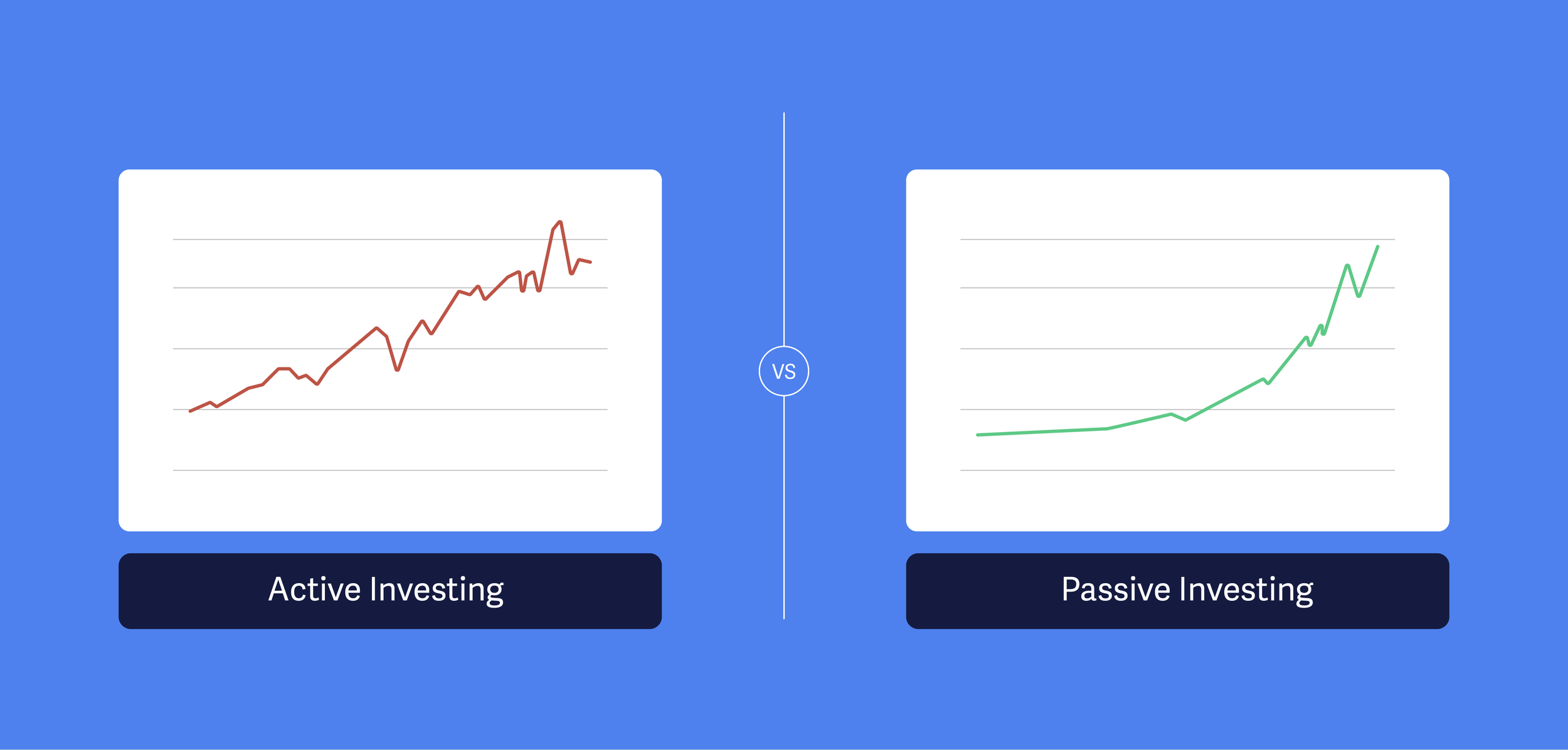
The decision to roll with either an active or passive investment strategy is one of the most hotly contested issues in finance. Here’s everything you need to know so you can make the right choice for your portfolio. New to investing? Start with our beginner’s guide on how to start investing.
Key Takeaways
- Two philosophies: Active investing tries to beat the market via research, timing, and strategies like growth, value, or momentum; passive investing simply tries to match the market by tracking an index.
- Data favors passive: Studies consistently show most active managers underperform after costs, though skilled managers can add value in less-efficient corners like emerging markets and small-cap sectors.
- Fees and taxes widen the gap: Even a 1% annual fee difference can cost hundreds of thousands over decades, and active trading generates more short-term capital gains than low-turnover index funds.
- Behavior matters as much as strategy: Active investors must resist chasing hot tips; passive investors must sit tight through downturns, since those who panic-sold in 2008 missed the rebound.
- Not either-or: A blended portfolio can use passive index funds as the core with active positions on the edges — but consistency matters more than the label.
Active vs. passive investing example
Imagine two friends decide to embark on their investing journeys on the same exact day. Alex is a hands-on investor who reads up on the market before bed and places trades with a confident click of the mouse, making calculated decisions based on which sectors are hot, which companies are poised to break out, and when to get out before prices dip. Taylor, in contrast, takes a hands-off approach and transfers money into a low-cost index fund that tracks the S&P 500 on a monthly basis, not analyzing quarterly earnings nor timing trades and avoiding Wall Street analyst reports.
At first glance, Alex’s method might seem more sophisticated and “investor-like.” Taylor’s strategy, meanwhile, may seem overly passive and even boring. After 10, 20, or 30 years, however, whose portfolio will likely have grown the most? This same question lies at the heart of one of the longest-running personal finance debates—active vs. passive investing—and first calls on us to take a step back and define each one.
Active investing: a hands-on approach
Active investing is built around one goal: to beat the market. Investors (or managers) use research, analysis, and timing to choose investments expected to outperform a benchmark (e.g., the S&P 500). This approach can take many forms, with investors implementing one of the following strategies (or a combination)…
Growth investing
This focuses on companies expected to expand at an above-average rate compared to their peers or the overall market, with investors often targeting firms in fast-growing industries (e.g., technology, biotechnology, or renewable energy) whereby innovation and demand drive rapid revenue increases. While growth stocks can indeed outperform the market, they’re also often more volatile than others and vulnerable to market downturns.
Value investing
This option—popularized by Warren Buffett and rooted in Benjamin Graham’s principles—involves seeking out companies whose stock prices appear undervalued relative to their intrinsic worth, believing the market sometimes misprices securities due to overreactions or short-term noise. Value investors look for strong fundamentals (e.g., steady earnings or solid balance sheets) that suggest a company is worth more than its current share price, ultimately expecting the market to recognize this discrepancy and push the stock higher over time.
Momentum investing
Momentum investing is based on the idea that stocks displaying solid recent performance will continue to rise whereas those on the decline will continue to fall. Investors who employ this strategy follow price trends closely, attempting to ride upward or downward swings for profit. The approach relies heavily on market psychology and timing rather than company fundamentals—making it riskier and more speculative—but when executed effectively can capture short-term gains during periods of strong market trends.
Sector rotation
Sector rotation involves shifting investments between different industries or sectors based on expected best performance under current or upcoming economic conditions. During an economic expansion, for example, investors might favor technology or consumer discretionary stocks but move toward defensive sectors (e.g., healthcare or utilities) during a slowdown.
No matter which specific active strategy is utilized, professional managers often run billion-dollar funds—with entire analyst teams studying markets, earnings reports, and macroeconomic data—whereas individual investors enlist the help of online brokerages, research companies, read reports, and make trades themselves.
Passive investing: the long game
Passive investing takes a radically different approach; rather than trying to beat the market, the goal is to match its performance while accepting that broad markets generally rise over long time horizons. Most passive investors buy index funds or ETFs that track benchmarks (e.g., the S&P 500, Russell 2000, or MSCI World Index), with the fund changing automatically when the index changes in the absence of stock-picking or market timing.
A passive investing strategy benefits from simplicity but also relies on discipline. After deciding on your allocation and setting up automatic contributions, you stay the course through booms and busts alike while removing frequent decision-making: shielding investors from emotional mistakes like panic selling during downturns or chasing fads at market highs.
The active vs. passive debate: a quick history lesson
For much of modern financial history, nearly all investing was of the active sort; investors wanting to build a portfolio in the 1920s or 1930s cherry-picked individual stocks or bonds by hand (with or without advisor help) based on the simple belief that skillful selection could beat average market performance.
The mid-20th century brought a wave of academic research that challenged this assumption, however, with economist Eugene Fama’s Efficient Market Hypothesis (EMH) arguing that asset prices already reflect all available public information and thus make it incredibly difficult to consistently “outsmart” the market.
In the 1970s, then, The Vanguard Group founder John Bogle launched the first retail index fund: his S&P 500 fund tracking the market rather than trying to beat it and charging far less in fees than traditional mutual funds. Wall Street mocked it at the time, calling it “Bogle’s folly,” yet his idea went on to reshape the entire investment world. Today, trillions of dollars sit in index funds just as the debate between active and passive investing remains one of the most important in finance.
Is active or passive investing better?
The biggest difference between active and passive investing lies in their unique goals, with the appeal of the former grounded in the possibility of outperformance—yet studies consistently show that most active managers actually underperform the market after costs are factored in.
That said, active management does shine in specific niches. In less efficient markets (e.g., emerging economies, frontier markets, or small, under-analyzed sectors), for example, skilled managers sometimes pinpoint mispriced assets and outperform. Nevertheless, data suggests passive strategies provide more reliable long-term results for the average investor; so while Alex’s portfolio may perform better than Taylor’s this month or even this year, Taylor’s passive investment strategy is historically more likely to see higher returns over the next two decades.
Fee and tax implications
As mentioned above, active management often involves higher fees than its passive counterpart. While the difference is relatively small in its own right, even a 1% disparity in annual fees can erode hundreds of thousands of dollars from an investor’s wealth over a series of decades.
Taxes are another key difference as active investing typically creates more taxable events. Frequent trading means realizing capital gains, often short-term gains taxed at ordinary income rates that are much higher than the long-term capital gains rate. In contrast, passive investing is typically more tax-efficient as index funds and ETFs have very low turnover—meaning fewer taxable distributions as an advantage primed to significantly boost after-tax returns, especially with respect to taxable accounts.
The behavioral side of investing
While it’s certainly important to consider the numbers, another critical element of passive and active investing to consider is the behavioral component. Active investing demands strong emotional control as investors must resist overconfidence, avoid chasing “hot tips,” and accept losses quickly when trades go wrong. Many active investors underperform not because their strategy is flawed but because they let fear or greed drive their decisions.
Passive investing, on the other hand, demands discipline in the opposite form: the willingness to sit still. When markets plunge, the instinct is to sell. During the 2008 financial crisis when the S&P 500 lost more than half its value, investors who panicked and sold locked in losses whereas those who stayed invested saw the market recover and more than quadruple in subsequent years.
Is active or passive investing right for you?
There’s no one-size-fits-all answer here, with your decision ultimately depending on your personality, lifestyle, and financial goals. If you enjoy digging into research, thrive on decision-making, and accept the risk of underperformance, active investing is perhaps the best fit. If you’d rather automate contributions, minimize costs, and spend less time thinking about the markets, however, passive investing is likely a better match.
Remember it’s also not an either-or decision as portfolios can include a combination of both passive and active investing strategies.
The takeaway: active vs passive investing
No matter which direction you head in, the most important factor isn’t which strategy you choose but instead just sticking with it. Markets will surge and crash, fads will come and go, and headlines will tempt you to change course. Having a consistent strategy you believe in—whether active, passive, or a blend—will almost always serve you better than chasing the latest trend.
Have questions about investing? Schedule a FREE discovery call with one of our CFP® professionals to get them answered.
Reviewed for accuracy
Benjamin Stark, CFP®
Financial Advisor and Director of Client Experience at Vision Retirement, with 10+ years as a financial advisor.
Read full bio →


Disclosures:
This document is a summary only and is not intended to provide specific advice or recommendations for any individual or business.
There is no assurance that the techniques and strategies discussed herein are suitable for all investors or will yield positive outcomes. Investing involves risks, including possible loss of principal.
No strategy assures success or protects against loss. There is no guarantee that a diversified portfolio will enhance overall returns or outperform a non-diversified portfolio. Diversification does not protect against market risk.